
Anúncios
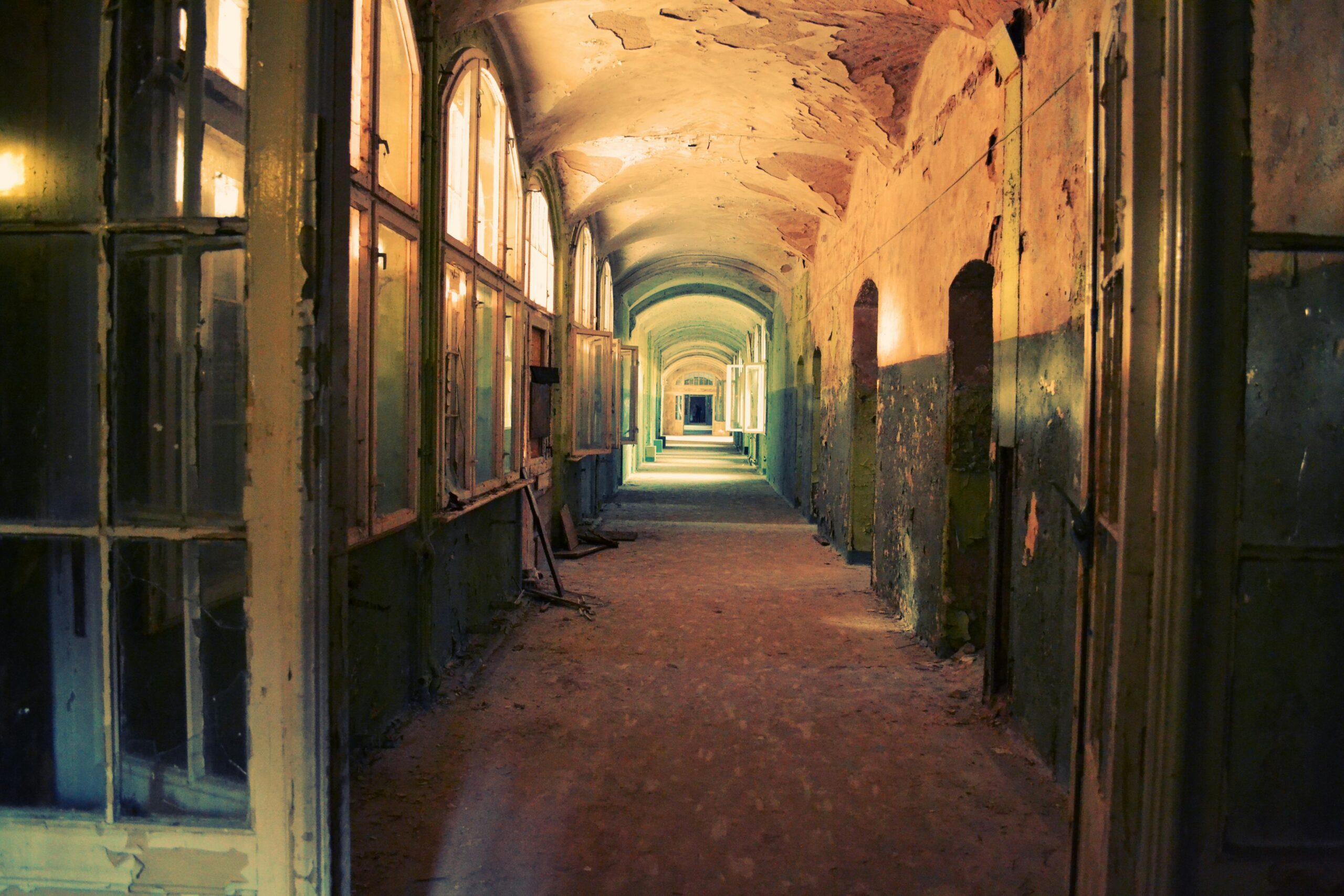
Step into a hallway where the walls whisper secrets of the universe, and every step forward might take you deeper into the unknown. 🚪
Throughout human history, we’ve been fascinated by spaces that challenge our understanding of reality. The concept of an endless passage—a corridor that stretches beyond comprehension, defying the very laws of time and space—captures our imagination like few other mysteries. These architectural anomalies appear in folklore, modern urban legends, and even scientific theories about the nature of our universe.
Anúncios
Imagine walking down a hallway in an ordinary building. The fluorescent lights flicker overhead, casting familiar shadows on beige walls. But something feels wrong. You’ve been walking for five minutes, then ten, then twenty. The exit door that should have been just ahead remains perpetually distant, as if the corridor itself is breathing, expanding with each step you take. This is the essence of the endless passage phenomenon—a space that refuses to behave according to our expectations.
🌀 The Architecture of Impossible Spaces
The endless hallway concept challenges fundamental principles of architecture and physics. In conventional understanding, a corridor has defined dimensions: length, width, and height. It connects two points in space, serving as a transitional area between destinations. But what happens when this simple concept becomes corrupted by forces we don’t understand?
Anúncios
Witnesses who claim to have experienced endless passages describe remarkably similar phenomena. The hallway appears normal at first glance, with standard features like doors, windows, light fixtures, and flooring. However, as they traverse the space, subtle anomalies emerge. Door numbers might repeat or skip in illogical sequences. The temperature fluctuates without apparent cause. Sounds echo in ways that don’t match the visible dimensions of the space.
Some researchers have attempted to categorize these experiences into distinct types. The “looping corridor” creates the illusion of progress while actually returning the traveler to their starting point. The “extending passage” physically or perceptually lengthens as one moves through it. The “fractured hallway” connects to multiple realities or timelines simultaneously, with each door potentially leading to a different version of reality.
Architectural Anomalies in Historical Records
Historical accounts of strange spatial phenomena date back centuries. Medieval castles sometimes contained passages that servants claimed would “shift” during certain times of year. Victorian mansions featured corridors that seemed longer when walked in one direction than the other. Modern skyscrapers have occasionally been the subject of rumors about maintenance levels that don’t match the building’s blueprints.
One particularly well-documented case involves a government facility built in the 1960s. Multiple employees reported becoming disoriented in a specific hallway on the third floor. Despite the corridor measuring only 150 feet according to architectural plans, several individuals claimed to have walked for over ten minutes without reaching the end. Security footage from the incident showed the subjects walking normally, then simply vanishing from one camera’s view without appearing on the next expected camera.
⏰ Time Dilation and Temporal Anomalies
The temporal aspects of endless passages may be even more disturbing than the spatial distortions. Numerous accounts describe individuals entering a corridor and emerging minutes, hours, or even days later, despite feeling that only moments had passed. Conversely, some report experiencing what feels like hours of walking, only to discover that mere seconds elapsed in the outside world.
These time distortions align intriguingly with certain theoretical physics concepts. Einstein’s theories of relativity demonstrate that time is not absolute but rather relative to the observer’s frame of reference. While these theories typically apply to objects moving at near-light speeds or experiencing extreme gravitational fields, could there be localized spatial anomalies where similar effects occur?
Dr. Helena Yuriev, a theoretical physicist specializing in exotic spacetime geometries, has proposed that certain architectural configurations might accidentally create what she calls “temporal pockets”—regions where the normal flow of time becomes distorted due to unknown factors. Her research suggests that specific combinations of materials, electromagnetic fields, and geometric proportions could theoretically produce measurable time dilation effects, though the mechanism remains purely speculative.
The Relativity of Corridor Experience
What makes temporal distortions in endless passages particularly fascinating is their subjective consistency. When multiple people experience the same anomalous hallway, they often report similar perceptual effects, even when separated by years. This suggests that the phenomenon, if real, has objective properties rather than being purely psychological.
However, the neurological component cannot be dismissed. The human brain constructs our experience of time based on sensory input and memory formation. Monotonous environments, like long featureless corridors, can significantly distort time perception. Studies have shown that people consistently underestimate time spent in repetitive, unchanging environments—a psychological effect that could explain at least some endless passage reports.
🔮 Dimensional Gateways and Parallel Realities
Perhaps the most fantastical explanation for endless passages involves multidimensional theory. According to string theory and related frameworks in modern physics, our universe may contain additional spatial dimensions beyond the three we experience daily. These extra dimensions are theoretically “compactified” or curled up at scales too small to observe directly.
Could an endless hallway represent a location where the boundaries between dimensional layers become thin or permeable? Some theorists propose that certain geometric configurations create “weak points” in the fabric of spacetime, allowing glimpses or even physical access to adjacent dimensional spaces. A person walking through such a corridor might unknowingly step partially into another dimensional layer, experiencing the resulting spatial distortions.
This concept resonates with older mystical traditions. Sacred architecture across cultures has long incorporated specific proportions and orientations believed to connect earthly spaces with spiritual realms. The Egyptian pyramids, Gothic cathedrals, and Hindu temples all demonstrate sophisticated geometric knowledge applied with intentional symbolic meaning. Could some of this ancient wisdom have accidentally—or purposefully—created passages that bridge different planes of existence?
The Topology of Impossible Corridors
Mathematicians have long studied impossible objects and non-Euclidean geometries that challenge conventional spatial understanding. The Möbius strip, Klein bottle, and Penrose stairs demonstrate that mathematical spaces can possess properties that seem impossible in our everyday three-dimensional world.
An endless hallway might represent a physical manifestation of such exotic topologies. Imagine a corridor that connects to itself in higher-dimensional space, creating a loop that’s imperceptible to three-dimensional beings walking through it. Or consider a passage that exists simultaneously in multiple spatial configurations, with the walker’s consciousness determining which version they experience at any given moment.
👻 Psychological and Perceptual Factors
While exotic physics and supernatural explanations capture the imagination, we must also consider the powerful role of human psychology in creating or amplifying the endless passage experience. The human mind excels at pattern recognition but can be remarkably unreliable when processing unusual or ambiguous sensory information.
Several psychological phenomena might contribute to endless hallway experiences. Proprioceptive drift occurs when our sense of body position becomes unreliable, particularly in disorienting environments. Highway hypnosis demonstrates how monotonous visual input can induce trance-like states where time and distance perception become severely distorted. Dissociative episodes, triggered by stress or fatigue, can create profound alterations in how we experience reality.
Environmental factors also play crucial roles. Poor lighting, unusual acoustics, and architectural features that subtly confuse spatial orientation can combine to create profoundly disorienting experiences. Some modern buildings, particularly those with repetitive floor layouts and insufficient wayfinding cues, inadvertently create conditions where even psychologically healthy individuals become confused about their location and the distance traveled.
The Power of Expectation and Suggestion
Once a location develops a reputation as an endless passage, expectation and suggestion can significantly influence subsequent experiences. People entering a reportedly anomalous corridor with preexisting beliefs about its strange properties will unconsciously interpret ambiguous sensory information in ways that confirm those expectations. This doesn’t make their experiences less real to them, but it does complicate efforts to determine objective truth.
Group dynamics further complicate matters. When multiple people experience the same anomalous corridor together, social conformity pressures and shared narrative construction can lead the group toward consensus about what happened, even if individual memories initially differed. Later retellings then reinforce and potentially embellish the shared story, creating a feedback loop where each iteration becomes more dramatically strange.
🏛️ Famous Endless Passages Around the World
Certain locations have developed enduring reputations as endless or otherwise anomalous passages. While hard evidence remains elusive, these sites continue to attract investigators, skeptics, and curious adventurers seeking firsthand experience of the impossible.
The Winchester Mystery House in San Jose, California, features numerous architectural oddities, including staircases that lead nowhere and doors that open onto walls. While not explicitly an endless passage, its labyrinthine design and strange history have made it a focal point for those interested in impossible architecture. The builder, Sarah Winchester, continuously added rooms and corridors for 38 years, allegedly following instructions from spirits, creating a building that defies conventional architectural logic.
In Eastern Europe, several Soviet-era facilities have developed reputations for spatial anomalies. These massive underground complexes, built during the Cold War for purposes ranging from military command centers to experimental research facilities, sometimes feature corridors extending for miles. The combination of their imposing scale, abandoned condition, and classified histories has spawned numerous legends about passages that lead to nowhere—or somewhere impossibly distant.
Urban Legends and Digital Age Mysteries
The internet age has democratized strange experiences, allowing people worldwide to share their encounters with anomalous spaces. Online forums dedicated to “glitch in the matrix” experiences regularly feature accounts of impossible corridors. While many can be dismissed as creative fiction, the sheer volume and consistency of certain details across independent reports deserves consideration.
The “Backrooms” concept, which emerged from internet horror fiction, imagines an infinite maze of empty office spaces and corridors existing outside normal reality. While explicitly fictional in origin, this modern myth resonates because it articulates an anxiety many feel about liminal spaces—transitional areas that exist only to connect more important locations, yet which can become traps if something goes wrong.
🔬 Scientific Investigation and Measurement Challenges
Serious investigation of endless passage phenomena faces significant methodological challenges. By definition, these experiences are rare, unpredictable, and often unrepeatable. Standard scientific protocol requires reproducible results under controlled conditions—criteria that alleged endless passages categorically fail to meet.
Nevertheless, some researchers have attempted systematic investigation. Measurement protocols typically include GPS tracking, laser distance measurement, time-synchronized video documentation from multiple angles, and physiological monitoring of subjects’ stress responses and cognitive states. However, most investigations of reportedly anomalous locations yield disappointingly normal results.
This absence of measurable anomalies under investigation conditions could indicate several things. Perhaps the phenomena are entirely psychological and dissipate under the heightened awareness of formal investigation. Alternatively, if the anomalies are real but sporadic, investigators may simply experience normal conditions during their limited observation windows. Some speculate that the act of intensive observation itself might somehow prevent the phenomena from manifesting—a concept reminiscent of quantum mechanics’ observer effect, though applied in a context far beyond that principle’s actual scope.
🌌 Philosophical Implications of Impossible Spaces
Beyond the question of whether endless passages actually exist lies the deeper philosophical question of what they would mean if they do. Our understanding of reality rests on assumptions about space, time, and causality that such phenomena would fundamentally challenge.
If spaces can exist that violate conventional geometry, what does this say about the nature of physical reality? Are the laws we’ve discovered through science truly universal and inviolable, or merely statistical regularities that admit rare exceptions? Could consciousness itself play a role in determining spatial properties, making reality more subjective and malleable than materialist philosophy suggests?
These questions connect to perennial debates in philosophy of mind and metaphysics. Idealist philosophers have long argued that physical reality depends fundamentally on consciousness rather than existing independently. Endless passages that respond to observers’ mental states would support such views. Conversely, materialists might argue that any genuine spatial anomalies must ultimately have physical explanations, even if current science cannot provide them.
🚶 Walking the Line Between Mystery and Meaning
The endless passage phenomenon ultimately represents something profound about human consciousness and our relationship with space. Whether these experiences reflect objective anomalies in physical reality, exotic psychological phenomena, or some combination of both, they reveal important truths about the limits of our understanding.
We live in an age that prides itself on scientific knowledge and rational explanation. Yet mysteries persist in the margins—experiences that resist easy categorization and challenge our comfortable certainties. The endless hallway stands as a symbol of all that remains unknown, a reminder that reality may be stranger and more complex than our current frameworks can accommodate.
For those who claim to have walked these impossible corridors, the experience often proves transformative. Whether interpreted as supernatural encounter, dimensional anomaly, or profound psychological episode, traversing a passage that defies normal space and time fundamentally challenges one’s assumptions about reality. Such experiences can inspire fear, wonder, curiosity, or all three simultaneously.
Perhaps the true value of endless passage stories lies not in determining their objective reality but in what they reveal about human consciousness. We are creatures who need narrative and meaning, who find our identity through orientation in space and time. When that orientation fails—when the hallway refuses to end, when time loses its reliable flow—we confront the fragility of the mental models through which we construct our world. In that confrontation lies both terror and liberation, the dissolution of certainty and the possibility of expanded understanding. The mystery persists, inviting each generation to step through the doorway and discover what lies beyond the familiar dimensions of everyday existence. ✨
