
Anúncios
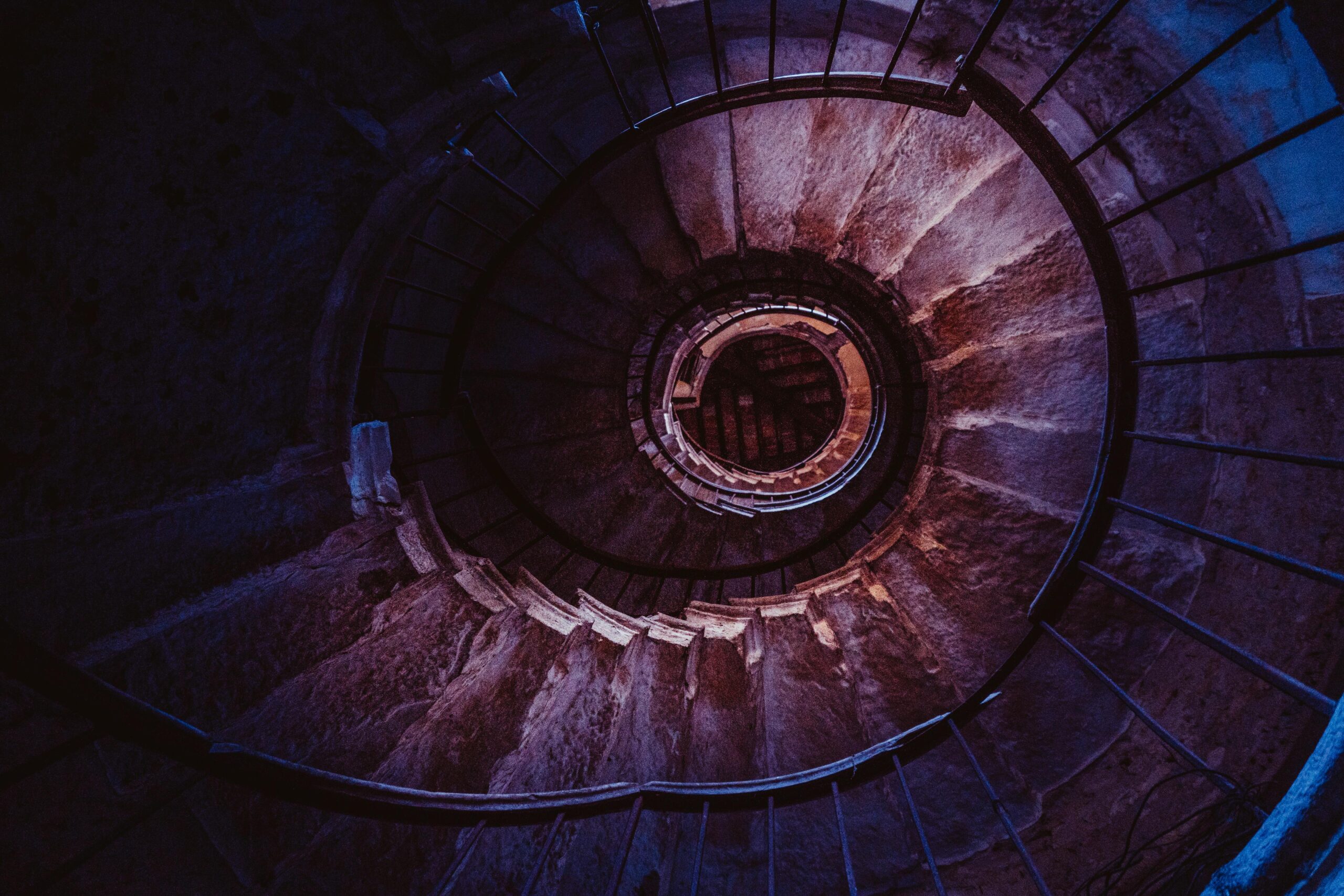
The infinite staircase has captivated human imagination for centuries, blending architecture, mathematics, art, and philosophy into an enigmatic symbol that defies our understanding of space.
🔄 The Paradox That Defies Reality
Imagine climbing a staircase that continuously ascends or descends, yet somehow returns you to your starting point without ever reversing direction. This seemingly impossible construct represents one of the most fascinating paradoxes in visual perception and spatial reasoning. The concept of a staircase without beginning or end challenges our fundamental assumptions about three-dimensional space and linear progression.
Anúncios
The impossible staircase exists at the intersection of multiple disciplines. Mathematicians study it as a topological curiosity, artists recreate it as visual illusion, architects contemplate its theoretical implications, and philosophers examine what it reveals about human perception and reality itself. This multifaceted mystery continues to inspire creative works, scientific inquiry, and endless fascination across cultures worldwide.
🎨 Escher’s Architectural Impossibilities
Dutch graphic artist M.C. Escher immortalized the endless staircase in his 1960 lithograph “Ascending and Descending.” The artwork depicts a monastery with a perpetual staircase where robed figures eternally climb or descend in an endless loop. Escher’s meticulous technique creates a convincing illusion that appears structurally sound at first glance, yet reveals its impossibility upon careful analysis.
Anúncios
Escher didn’t invent the concept from nothing. He drew inspiration from the Penrose stairs, a geometric impossibility conceived by geneticist Lionel Penrose and his mathematician son Roger Penrose in 1958. The Penroses published their impossible staircase as a counterintuitive geometric figure that could exist on paper but never in three-dimensional reality.
What makes Escher’s interpretation particularly powerful is his ability to embed this mathematical impossibility within believable architectural contexts. His staircases don’t float in abstract space—they appear as solid stone structures with convincing shadows, textures, and perspective. This juxtaposition between realistic rendering and impossible geometry creates cognitive dissonance that captivates viewers.
📐 The Mathematics Behind the Mystery
The impossible staircase represents a fascinating mathematical paradox rooted in non-Euclidean geometry and topological manipulation. In standard three-dimensional Euclidean space, a continuous path that always ascends cannot return to its starting point without descending at some point. The endless staircase violates this principle through clever visual trickery.
The secret lies in how the two-dimensional representation exploits ambiguities in depth perception. When we view a drawing, our brain interprets flat lines and angles as three-dimensional forms based on learned conventions about perspective. The impossible staircase manipulates these conventions by making local connections that each seem geometrically valid, but collectively create a global impossibility.
Consider how each individual step connects logically to its neighbors. Viewed in isolation, every corner, every rise, every tread appears structurally sound. The impossibility only emerges when you trace the complete circuit. This reveals an important mathematical principle: local consistency doesn’t guarantee global consistency in geometric systems.
🧠 Perception, Cognition, and Reality
The endless staircase reveals profound truths about human perception and cognition. Our visual system didn’t evolve to detect impossible objects—it developed to quickly interpret our immediate physical environment for survival purposes. When confronted with cleverly constructed impossible figures, our perceptual mechanisms produce contradictory interpretations that our conscious mind struggles to reconcile.
Neuroscience research shows that when viewing impossible staircases, different brain regions activate in sequence as we attempt to resolve the contradiction. Initial visual processing accepts the image as coherent, but higher cognitive functions detect the logical inconsistency. This creates a fascinating feedback loop where perception and cognition compete rather than cooperate.
The phenomenon demonstrates that perception isn’t passive reception of reality but active construction. Our brains constantly generate predictions about the physical world based on incomplete information. Impossible staircases exploit these predictive mechanisms, revealing the assumptions and shortcuts our neural architecture employs to navigate reality efficiently.
🏛️ Historical and Cultural Manifestations
While Escher popularized the impossible staircase in Western consciousness, similar concepts appear throughout human cultural history. Ancient mythology across civilizations features endless journeys, cyclical pathways, and spaces that defy normal geometry. These recurring motifs suggest the endless staircase taps into deep-rooted human fascinations with infinity, eternity, and transcendence.
Buddhist and Hindu philosophy contains concepts remarkably parallel to the endless staircase. The wheel of samsara represents an endless cycle of rebirth without beginning or end—a spiritual version of the perpetual climb. Medieval European cathedrals sometimes featured labyrinth designs representing spiritual journeys that wind endlessly before reaching enlightenment at the center.
Indigenous Australian cultures speak of songlines—invisible pathways connecting sacred sites across vast distances in networks that loop back upon themselves. While not physical staircases, these conceptual maps share the quality of cyclical journeys without clear beginning or terminus, suggesting the endless staircase resonates with fundamental human experiences of space and journey.
🎬 Infinite Stairs in Modern Media
Contemporary cinema, video games, and literature frequently employ endless staircases as metaphorical devices and narrative elements. Christopher Nolan’s “Inception” features Penrose stairs during the architectural tutorial scene, using the impossibility to signal the dream world’s flexible physics. The film leverages audience familiarity with impossible geometry to establish its alternate reality ruleset.
Video games have unique opportunities to implement endless staircases literally rather than illusionistically. Games like “Monument Valley” and “Echochrome” build entire gameplay mechanics around impossible geometry, allowing players to navigate Escher-inspired environments by shifting perspective. These interactive experiences transform the endless staircase from static paradox to dynamic puzzle.
Horror media particularly favors endless staircases for their psychological impact. The SCP Foundation’s fictional “SCP-087” describes an endless descending staircase that becomes progressively more disturbing—a digital-age campfire story exploiting the existential dread of spaces without exit or origin. The endless staircase naturally evokes feelings of entrapment, futility, and cosmic insignificance.
🔬 Scientific Applications and Implications
Beyond artistic fascination, impossible staircases have practical applications in cognitive science and computer vision research. Scientists use them to study how human visual systems construct spatial representations from two-dimensional retinal images. The systematic ways people interpret impossible figures reveal the algorithms our brains employ for depth perception.
Computer graphics researchers study impossible geometry to improve rendering algorithms and create more convincing visual effects. Understanding how impossible figures fool human perception helps programmers design better compression algorithms that preserve perceptually important information while discarding irrelevant data. The endless staircase becomes a test case for distinguishing signal from noise.
Some theoretical physicists have drawn analogies between impossible staircases and certain cosmological models. Closed timelike curves in general relativity create temporal loops where cause follows effect in endless cycles—a temporal version of spatial impossibility. While highly speculative, these connections suggest impossible geometry might offer intuitive models for counterintuitive physics.
🎭 Philosophical Dimensions of Impossibility
The endless staircase raises profound philosophical questions about the relationship between representation and reality. If we can draw or conceive of structures that cannot physically exist, what does this reveal about the nature of imagination, mathematics, and physical law? These questions touch foundational issues in philosophy of mind and metaphysics.
Some philosophers argue impossible figures demonstrate the independence of mental representation from physical constraint. Our conceptual systems can manipulate symbols and images in ways that don’t correspond to possible physical arrangements. This cognitive freedom might be essential for abstract reasoning, counterfactual thinking, and creative innovation.
Others contend impossible staircases reveal limitations rather than freedoms. They show how easily our cognitive systems can be deceived, how our intuitions about space can mislead us, and how perception can diverge from reality. From this perspective, impossible figures are cautionary tales about trusting appearances and the necessity of rigorous logical analysis.
🏗️ Attempts at Physical Implementation
Despite their theoretical impossibility, artists and engineers have created physical installations that approximate endless staircases through clever techniques. These real-world constructions don’t violate geometry but instead use forced perspective, mirrors, and strategic viewing angles to recreate the illusion three-dimensionally within constrained contexts.
The Rochester Institute of Technology houses a physical Penrose staircase that appears impossible when photographed from specific vantage points. Walking around the structure reveals how it achieves its effect—the stairs occupy different planes that only appear connected from particular angles. These installations demonstrate that “impossible” staircases can exist as view-dependent illusions rather than true physical objects.
Virtual reality technology enables even more convincing implementations. VR environments aren’t constrained by physical geometry, allowing designers to create spaces where users genuinely experience walking endlessly ascending staircases. These digital constructions produce fascinating psychological responses, including disorientation, wonder, and sometimes profound unease as users confront experiential impossibility.
♾️ The Symbolism of Endless Ascent
Beyond technical and perceptual interest, the endless staircase carries rich symbolic resonance. It represents futile labor like Sisyphus eternally pushing his boulder, spiritual journeys toward unattainable enlightenment, or the modern condition of perpetual striving without satisfaction. Different viewers project different meanings onto the same geometric paradox.
In contemporary discourse, the endless staircase often symbolizes social mobility structures that promise advancement but actually maintain existing hierarchies. The metaphor captures how individuals can work ceaselessly, climbing constantly, yet find themselves structurally prevented from reaching higher social strata—movement without progress, effort without achievement.
Conversely, some interpret endless staircases optimistically as representing infinite potential and perpetual growth. From this perspective, the absence of a final destination isn’t frustrating limitation but liberating openness. The journey becomes the purpose itself, with each step valuable regardless of any ultimate arrival. The same geometry accommodates contradictory philosophies.
🌀 Creating Your Own Impossible Geometry
Artists and enthusiasts can explore impossible staircases through various creative media. Drawing impossible figures requires understanding basic perspective rules well enough to deliberately violate them strategically. The process teaches valuable lessons about visual representation, spatial reasoning, and the constructive nature of perception.
Digital tools have made impossible geometry more accessible than ever. 3D modeling software allows creators to construct impossible staircases by selectively disabling collision detection and geometric constraints. Video editing enables forced perspective tricks that would require elaborate physical staging. These technologies democratize impossible architecture previously limited to skilled technical illustrators.
Educational contexts increasingly use impossible figures including endless staircases to teach critical thinking about evidence and perception. Students learn that convincing visual presentations don’t guarantee logical coherence or physical possibility. This lesson extends beyond geometry to media literacy, scientific reasoning, and skeptical thinking applicable across domains.
🎪 The Enduring Mystery
The staircase without beginning or end continues captivating new generations despite decades of familiarity. Its appeal persists because it engages multiple levels of human cognition simultaneously—visual, spatial, logical, and emotional. The impossible staircase isn’t simply solved and dismissed but repeatedly experienced as fresh paradox with each encounter.
Perhaps the endless staircase endures because it mirrors something fundamental about human existence itself. We inhabit bodies that traverse physical space while minds that conceptualize impossible abstractions. We experience time as linear progression while living within cyclical patterns. We seek ultimate meanings and final destinations while actually inhabiting perpetual middles.
The mystery of the impossible staircase ultimately isn’t just geometric but existential. It confronts us with questions about reality, perception, possibility, and meaning that resist definitive resolution. Like the staircase itself, our inquiry circles back to where it began, yet somehow arrives somewhere new. The steps continue endlessly, inviting perpetual exploration of what seems familiar yet remains eternally strange.
Whether encountered in Escher’s prints, modern video games, philosophical thought experiments, or mathematical proofs, the staircase without beginning or end reveals how human creativity can transcend physical constraints while remaining grounded in them. It demonstrates our unique capacity to imagine the impossible, represent the unreal, and find meaning in paradox—ascending and descending simultaneously on stairs that lead everywhere and nowhere.
